

How Many Gods?
Who is the God Who Drowned Pharaoh’s Army?
I was sitting in a church service when it happened.
The preacher was working through the Exodus narrative—the plagues, the Passover, the crossing of the Red Sea. Good material. Ancient, dramatic, foundational. And then he made his move: he drew a straight line from Yahweh destroying the Egyptian gods to how we should understand God today, and how we should act accordingly.
I can’t remember the exact application, only the feeling. Something felt off. Not morally wrong—more theologically wrong. The line he drew was too straight. The gap between that God and the one Jesus describes was too wide to cross without explanation.
That question has stayed with me ever since.
Two gods. Or one god with a very long development arc.
The options for resolving this have been around for almost as long as Christianity itself.
The Gnostics proposed a clear division: the God of the Old Testament is the Demiurge—a inferior, possibly evil creator deity, unaware of or unconcerned with the higher God that Jesus refers to as Father. Marcion, in the second century, took this idea to its logical extreme and suggested a canon excluding the Hebrew Bible. Just Paul and a shortened Luke. Problem solved.
Except it wasn’t. Marcion was declared a heretic. The full canon was retained. And the church has been managing the tension ever since—sometimes by allegory, sometimes by progressive revelation, sometimes by simply not reading Exodus 12:12 too carefully.
I will execute judgment against all the gods of Egypt.
That’s not a metaphor. That’s a war declaration. Yahweh enters the Egyptian pantheon as a competitor and wins. The plagues are not natural disasters. They are targeted strikes against specific deities. Ra gets three days of darkness. Hapi gets blood. Osiris gets the firstborn.
This is a god defined by context—by the gods around him, by the political theology of the ancient Near East, by the cognitive and moral universe of the people who wrote the text.
Spiral Dynamics offers a hermeneutic that most seminaries don’t teach.
Every text is written by someone. That someone thinks within a value system—a worldview shaped by the complexity of their culture, their moment, their survival conditions. What Clare Graves mapped, and Don Beck and Chris Cowan developed into Spiral Dynamics, gives us a language for this: value memes, nested developmental levels, each with its own logic, its own God-image, its own ethics.
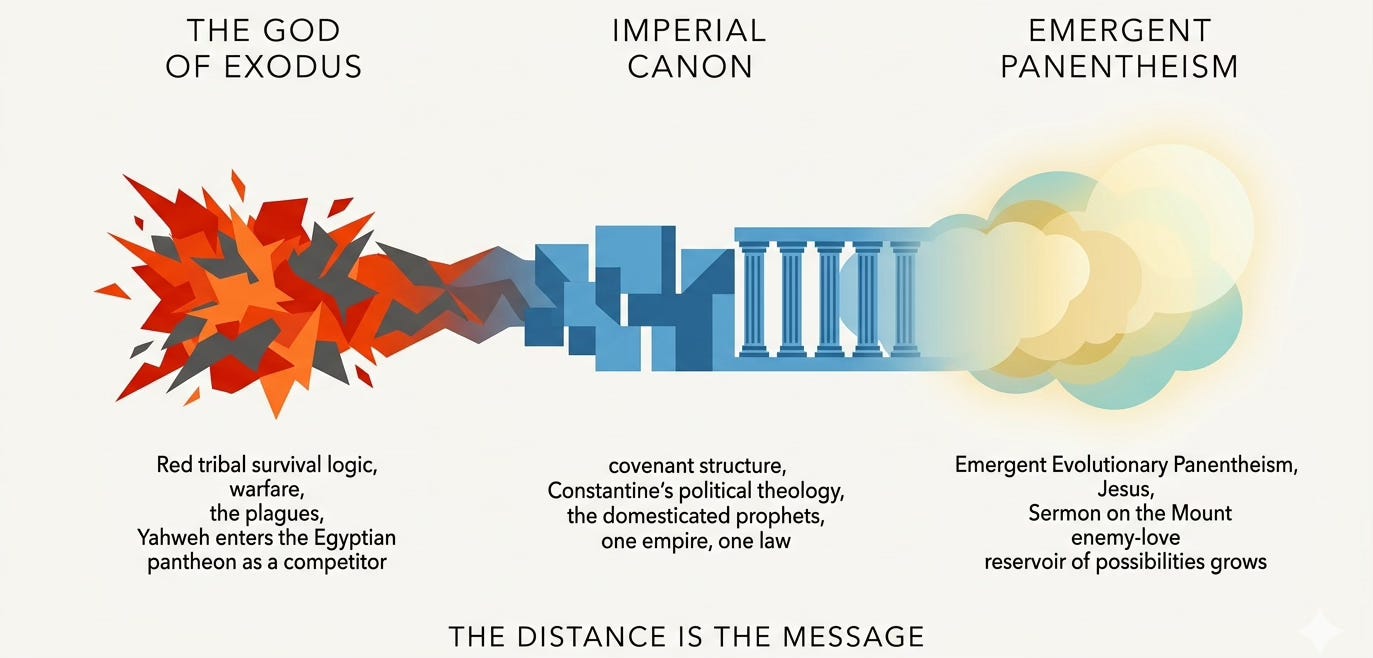
The Exodus narrative is not confused. It is Red giving way to Blue—tribal survival logic beginning to organize itself into covenant structure. A God who fights for his people, who defeats rival powers, who demands exclusive loyalty: this is exactly the divine image that Red/early-Blue cognition produces. Not because the authors were lying. Because this was the most complex image available to them. The most beautiful move God could offer, given what the reservoir of human consciousness had so far produced.
No text is false. No text is the final word.
The prophets complicate this picture in interesting ways. Amos and Micah and the later Isaiah are sharper, more universal, more ethically demanding. They are, by any Spiral reading, operating at a higher level of complexity. And yet they were preserved alongside the war narratives. The canon contains its own development—its own argument with itself.
Which raises an uncomfortable question: why this canon?
Constantine had a vision. And he needed a god who could run an empire.
The political theology of the fourth century deserves more honest attention than it usually gets.
Constantine’s conversion—whatever its inner reality—was structured by Purple logic: a magical sign, a cosmic guarantee, a divine protector before battle. His political project was Blue: one empire, one law, one religion as the binding force. And underneath both, the Red capacity for decisive, violent consolidation.
The New Testament alone is a poor fit for this project. The Sermon on the Mount is not an imperial document. “My kingdom is not of this world” is not a foundation for state religion. Loving enemies is not a military strategy.
The Old Testament, however, is full of useful material. A God who commissions kings. A God who sanctions war. A God who demands the loyalty of entire peoples and punishes defection with catastrophic force. A God whose narrative gives theological weight to conquest and empire.
Marcion’s proposal—drop the Hebrew Bible, keep only the Gospel—was not rejected purely on theological grounds. It was also politically inconvenient.
This is not a cynical reading. It is a Spiral reading. People at Purple/Red/Blue don’t consciously select texts for political utility. They resonate with what matches their value structure. The canon that emerged through the fourth and fifth centuries felt true to its architects because it was consonant with the God-image their worldview could produce.
The prophetic literature survived, too. But notice what happened to it. Amos’s social critique became predictive prophecy about Jesus. Isaiah’s servant songs became Christological proof-texts. The subversive content was preserved—and domesticated. Texts of higher complexity were read through lower-complexity frames. The canon held them. The interpretation neutralized them.
This is not unique to Christianity. It is how cultural transmission works.
Emergent Evolutionary Panentheism offers a theological account of the same movement.
Don’t know what Emergent Evolutionary Panentheism is? I explain it in my book The Mirror Works Both Ways, which can be pre-ordered on Amazon and will be released on April 8th, 2026, my birthday. It is based on process theology but differs in its definition of the reservoir of possibilities from which God can choose to lure us onward.
If the primordial reservoir of possibilities grows with creation—if God can only offer what the accumulated weight of past events has made available—then the God of Exodus is not a different God than the one Jesus describes.
He is the same God, working with what existed then. And then, he is a different God, a younger version of himself, with fewer possibilities at his hands.
Before the axial age, before the cognitive revolution that made universal ethics thinkable, before consciousness had developed the conceptual tools to receive an ethic of enemy-love: the lure toward the most beautiful available move looked like Yahweh defeating the gods of Egypt. Not because God preferred that. Because that was the move available. The repertoire was smaller. The initial aim was constrained by what creation had so far produced.
Jesus is not a correction. He is an emergence—something that became possible only because of everything that came before, including the war narratives, the covenant law, and the prophetic protest. You cannot skip to the Sermon on the Mount without the history that made it thinkable. Pastivity matters: the past doesn’t disappear. It becomes the sediment through which the next move is made possible.
This is why the Old Testament belongs in the canon—not despite its violence, but because of its developmental honesty.
It shows us where we came from. It shows us what God could offer then. And it makes the distance to Jesus visible—which is precisely the point. If Scripture only ever showed us the destination, we would not understand that it is a destination. We need to see the road.
The preacher who drew a straight line from the Exodus war-god to today was not wrong to find the text important. He was wrong to flatten the distance. The distance is the message.
A God who works with what exists—who can only offer the most beautiful move given the actual state of creation—is not a diminished God. He is a God genuinely in relationship. Not managing from above. Moving with what is.
That’s a different sermon than the one I heard. I think it’s a more honest one.
Which God-image do you carry most naturally—and which value meme shaped it?
What would it mean for your reading of the Old Testament if God’s options were genuinely limited by the consciousness available to receive them?
If the canon was shaped partly by political theology, does that undermine its authority—or does it make the subversive texts within it more remarkable?
Where in your own tradition have texts of higher complexity been domesticated by lower-complexity readings?
Don’t forget to pre-order my book, The Mirror Works Both Ways: What Creating Artificial Intelligence Reveals About God.