
Free Will
It is not what you think it is.
In my books, I talk about free will, without ever touching the age-old debate around it. I did that on purpose because I think that the worldview the normal treatise works from is wrong. It causes us to come up with a dichotomy that has nothing to do with real life.
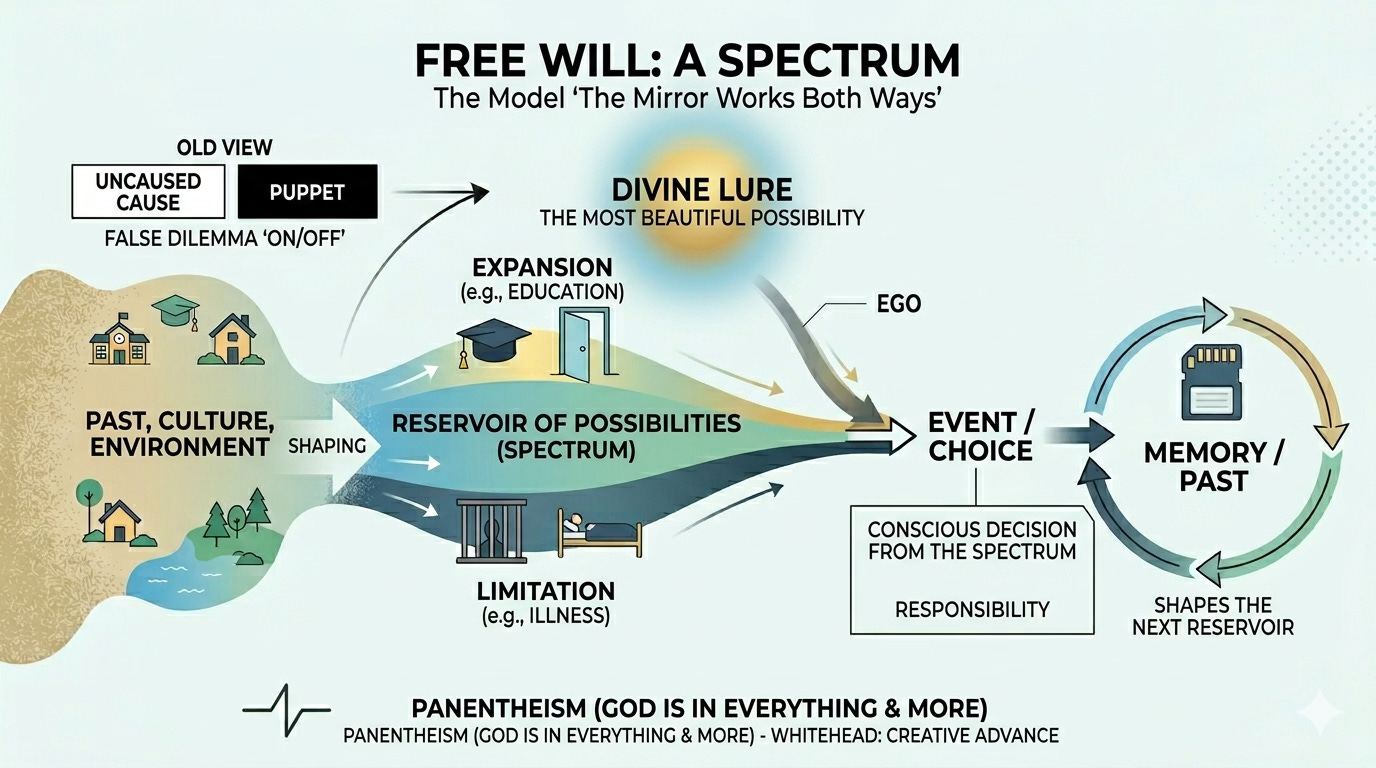
Remember, we usually think of free will as either an uncaused cause or a predetermined puppet on a string. Either we can freely choose or are forced to do what has been predetermined by some other force.
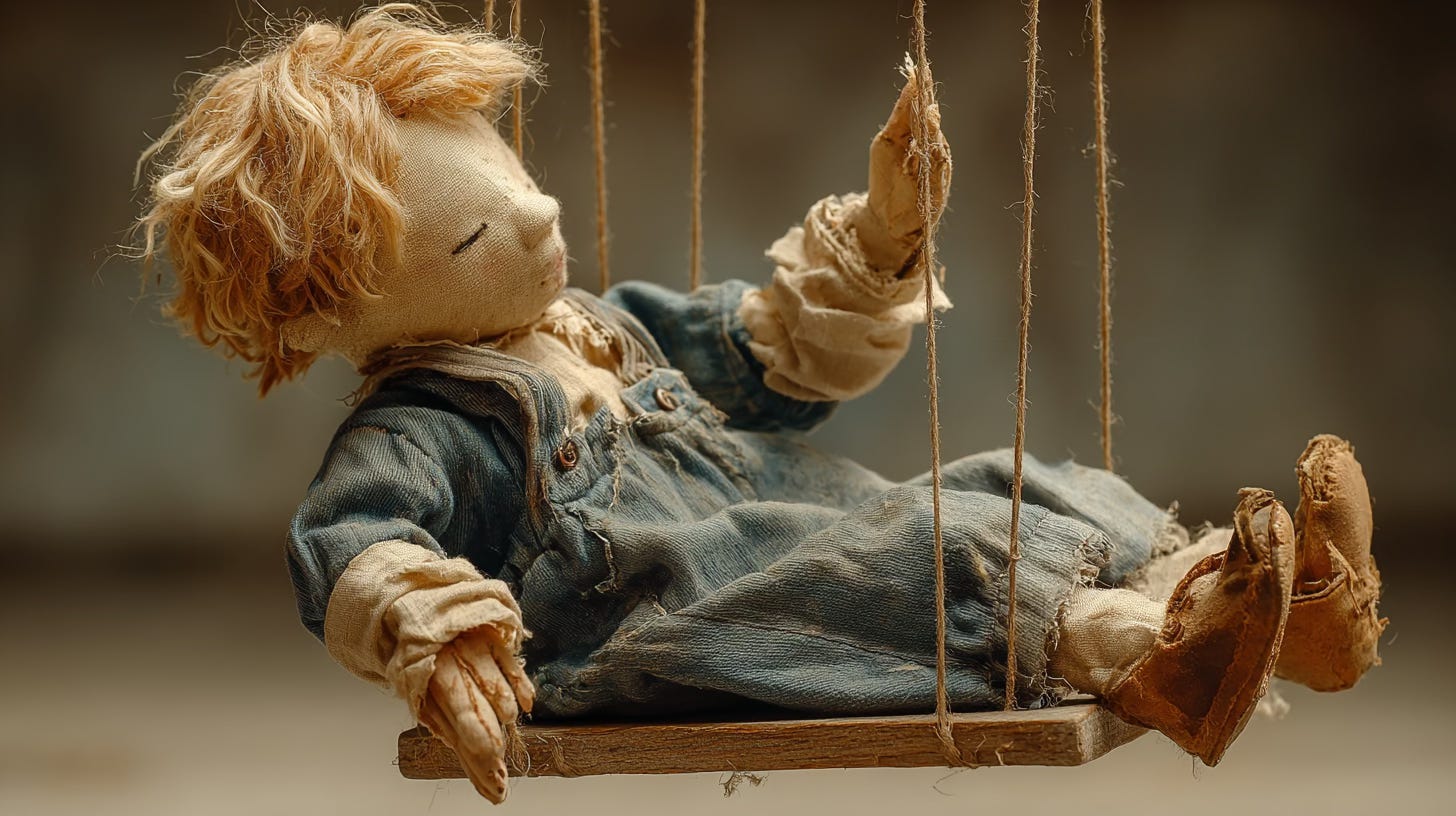
This results in an interesting problem around responsibility. In this dualistic model that knows only black and white, on and off, we are either responsible for every action we take or not responsible at all.
We come up with interesting workarounds. We either construct something like perceived simulated free will or construct a homunculus sitting somewhere in our mind that does the pulling of the strings, but has perfect free will.
We have to do this because of another dualism we fall prey to. We think that somehow we are separate from the environment we live in.
Let me give you an example. I just drank my first cup of coffee. That was a conscious decision I made. I could have drunk it earlier or later, or for once skipped it altogether.
But what had to happen for me to drink this coffee? I have used this example many times with novice programmers to see whether they have the skills needed for the profession. They had to come up with a list of actions required to have the coffee ready.
Most of these steps depend on the things involved—be it my muscles that need to contract and release at the exact right moments to act on the world, or the coffee maker that needs to function reliably—and do not exercise any free will of their own. Imagine this for a second. If they were to decide on their own, how many times would I get a coffee, I mean, all the way down into my stomach?
This duality between me and my environment is necessary because, otherwise, if the environment lacks free will to reliably make things happen according to my will, I cannot have any.
But where does this duality take place? My muscles, nerves, and body need to be intricately controlled to interact with the environment. Thus, the homunculus I spoke about. We call it the mind or the self.
So, do we lack free will, or do we live in an intricately dualistic world?
In my newest book, The Mirror Works Both Ways, I develop an epistemological model that includes true novelty and depends on and makes possible free will. But how does such free will look like in this model, overcoming the constructed dualism?
Let me briefly repeat the model. I see God as three functions: the primordial, the persuasive, and the receptive.
The primordial originally consists of one possibility and a desire to realize this possibility, which I call creativeness.
The persuasive searches the reservoir of possibilities and offers the one that leads to the most beautiful outcome, the initial aim. It is also called the lure, as it lures free-willed agents into realizing this initial aim.
The receptive receives every single realized possibility and adds it to the memory of the past, which in turn creates and eliminates possibilities from the reservoir that are newly available or no longer available, given the complete past up to the present.
We call the act of realizing a possibility an event, and the chain of events a process. There are no things in this model because each event changes what we perceive as a thing. It only makes sense to talk about processes. You are such a process, the present, ever-changing representation of a chain of events that resulted in you.
Let’s now look at the reservoir of possibilities that are available to you at a specific moment in time. It does not only depend on your desires or thoughts. It has been built and reshaped throughout your own history. It contains possibilities that heavily depend on your culture, upbringing, age, and the financial status of your parents and yourself, while the same things and more limit what is possible.
Not only that. Your environment also expands and limits what is possible. If you are swimming in a pool, you experience other possible next moves than when you are lying in bed or working in an open-floor office.
We can now define free will as the act of choosing your next step from the set of possibilities that the whole history of what brought you here allows for and has built.
Free will is not an on or off in this scenario. It is a spectrum. Getting sick will limit free will, as does being thrown into prison, while a university education expands the possibilities for acting freely, as does living in a Western democracy. At the same time, each of those opens up other possibilities.
You can certainly see that our belief system, worldview, and what we pay attention to influence what is possible, reshape the reservoir. This is where Spiral Dynamics provides a coarse but helpful model for understanding other people better. Many of the decisions people in another value meme make are not malicious. They act within the limitations of their reservoir of possibilities. What they do might be the most beautiful move they are capable of. This would mean that they follow the godly lure. You have other possibilities at your disposal; the lure is different. No need to judge. No need for jealousy.
This shapes what we call responsibility. We cannot be responsible for what was never in our reservoir. We are responsible for not following the lure presented to us, taken from the reservoir available to us.
This is visible in the parable of the talents in the Gospels. It expresses itself in the phrase, “From the one who has been entrusted with much, much more will be asked.” The bigger the reservoir, the more responsibility there is.
But did I really remove the duality from the system?
It is eliminated once we become aware that everything constitutionally contains the three functions.
That includes everything from matter to life to consciousness, from quark to human being.
Matter has a limited lure and reservoir, as dictated by physics and chemistry. The lure’s freedom and the reservoir grow in complexity with the system.
Panentheism defines God as in everything and more. We can see the godly lure as the sum of all lures and more. Whitehead calls this the creative advance toward a cosmic telos. In my model, this telos is not predetermined but is created through a dialogue among all lures, including God’s.
This plays out even in the most mundane moments. Back to my example of morning coffee. Following my lure, I decide to have a coffee from my reservoir, since I have a coffee maker, coffee capsules, a cup, and enough time. My muscles operate from their own reservoir of possibilities and lure—shaped by training, physicality, and health. Their reservoir is narrow enough that the outcome looks deterministic. But the structure is the same: a lure, a reservoir, an event.
If I lack the knowledge to operate the coffee maker or the ability to move my arms due to a stroke, my initial reservoir is limited. I might have to ask my wife to help me.
My lure might be biased. Actually, it is biased by definition. It does not have access to the full memory of the past and only knows the lure and the reservoirs of other free-willed agents in limited ways. Granted, on our path through the value memes of Spiral Dynamics, we learn to adopt a greater “We” in our decision-making. And we learn to manage our own whims in more productive and serving ways.
In one of my previous pieces (see below), I described how we cannot definitively discern between God’s lure and our ego dressing up as God.
This is the purpose and meaning of life: to mature and get better at it.
If you want to dive deeper into the theological framework that lies behind all this, pre-order my book, The Mirror Works Both Ways: What Creating Artificial Intelligence Reveals About God.
Just like the book, this article resulted from a long dialogue with AI.